
Changing Pad Cover
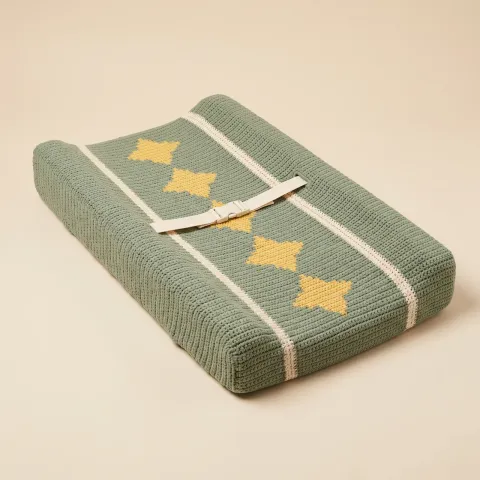
Crochet a fitted cover for a contoured changing pad about 31 to 32 inches long, 16 inches wide and up to 4 inches high. You chart the top panel, which comes with a sage ground, cream lines and a row of five butter yellow stars to keep or replace with your own design. Then you work the sides down from the panel in rounds and finish with a stretchy ribbed hem that tucks under the pad. There is no elastic, tie or button, and your pad's own safety strap stays exactly where it is: the pattern shows you where to leave a slot for it.
You get an editable chart for the top panel and a printable PDF with a written row for every row and a stitch count for every round.
You'll need:
- Worsted-weight cotton or a smooth cotton blend in three colors: sage, cream and butter
- A crochet hook, about 4.5 mm (change it to match your gauge), plus a hook one size smaller for the ribbed hem if you like
- A yarn needle, scissors and a few stitch markers
Size:
- Top panel about 31.7 x 16.75 in (81 x 43 cm); 111 stitches by 67 rows. Measure your pad before you start: pads vary by a few inches, and the pattern shows how to change the panel to suit.
It is worked in single crochet (US; UK double crochet) for the panel and the walls, and front and back post double crochet for the hem. Make a gauge swatch first, and a small swatch of the ribbing. Yarn amounts: weigh your swatch to estimate; amounts vary with tension.
Difficulty: Intermediate (a second color carried inside the stitches, rounds picked up from the panel's edge, post stitch ribbing and strap slots). Craft: Crochet. Tags: nursery, changing pad, changing table, baby shower, cover, tapestry crochet. Colors are approximate.
Important Safety Notes
Not for the sleep area: Keep this out of the crib, bassinet and play yard with a baby under 12 months, and do not use it for sleep. The American Academy of Pediatrics advises a "firm, flat sleep surface" and a "fitted sheet only", with nothing else in the crib.
Changing pad: Never cover, shorten or tie your changing pad's own safety strap, and keep its buckle and fastenings free. A strap is not enough on its own: never leave a baby alone on a changing pad, even for a moment, and keep supplies within your reach but out of the baby's.
Elastic: Use soft, non-roll, latex-free elastic that stays fully enclosed in the hem, so no end, loop or piece can come out. Stop using the item if elastic shows, frays or goes slack.
Yarn and care: Use soft, smooth, washable yarn that does not shed or fuzz, and wash a swatch first. Weave in every end and check inside the finished item for loose strands, which can wrap around a baby's fingers or toes. Wash inside out.
Close stitches: Work a firm, closely stitched fabric. Gaps and lacy openings can catch small fingers and toes.
If you sell what you make: Children's products sold in the US must meet CPSC rules, including testing, a Children's Product Certificate and a tracking label. Start at cpsc.gov.
$5.99
Buy in the StitchWing app
In StitchWing, choose Template Store and find this design.
Get StitchWingWhat you get
Charts and written rows for every size, as a PDF and a StitchWing file.
Works in StitchWing 1.0.1 or newer
Sizes
- Standard contoured pad · Measure your pad before starting; check that the cover stays fitted and its safety strap remains free. · Target gauge: 14 stitches × 16 rows per 4 inches, washed and blocked. Make a gauge swatch first; adjust hook size to match.
What’s new
Initial pattern release.
Good to know
Updates are free and never overwrite your saved work. Downloads open offline once saved. Patterns you’ve saved always open and print. Editing in the free version follows its limits. 30-day refunds.